
Carbide End Mill
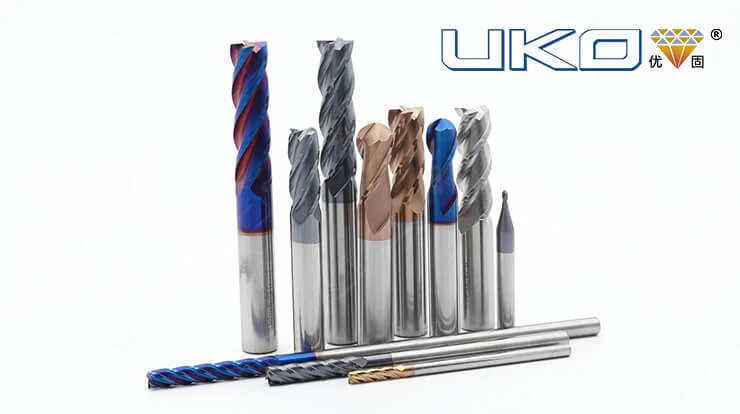
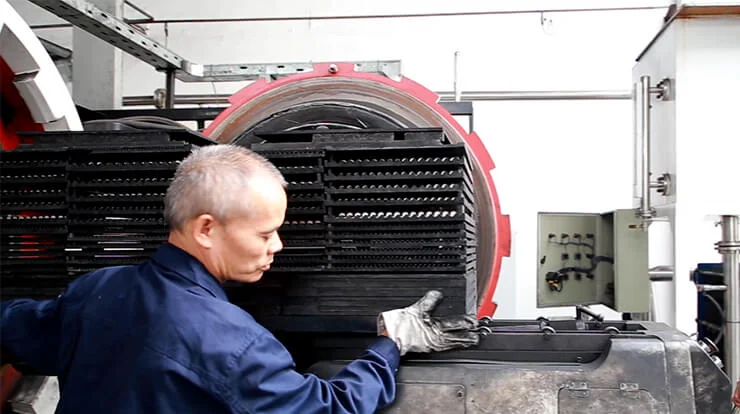
UKO carbide end mills are widely used to machining carbon steel, alloy steel, hardened steel, stainless steel, aluminum materials in mold and auto parts industries. From the selection of raw material carbide rods to the application of advanced technology and production or inspection equipment, every production process is strictly controlled to ensure the accuracy of end mills.
UKO offers a variety of cost-effective end mill products, including General Use End Mill for alloy steel, carbon steel below HRC45; High-Performance General Use End Mill for hard steel below HRC55; High Speed & Hard Processing End Mill for materials below HRC68; Stainless Steel Use End Mill; End Mill for Aluminum; End Mill for Graphite and Composites. Our technicians can provide you with professional advice on selecting the most suitable end mills, help you to find efficient and cost-controlled metal cutting tools, and highly improve your working efficiency.
Category
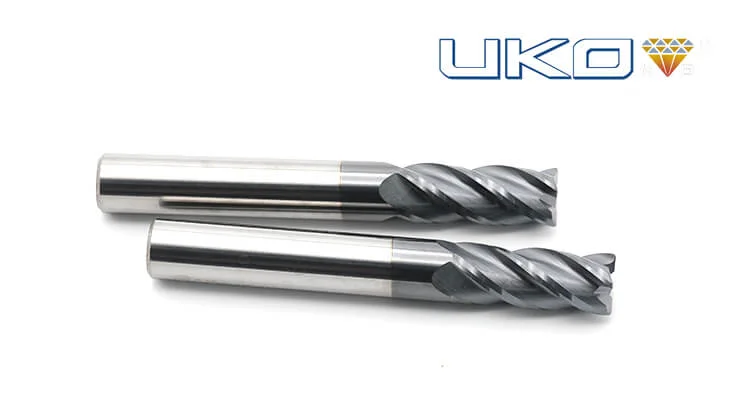
 Solid carbide end mills are suitable for alloy steel, and carbon steel below HRC45.
Features:
- Sharp cutting-edge design ensures tool strength and higher cutting efficiency.
- Adopts high-performance AICrXN coating, which is resistant to high temperature, wear and impact.
- Suitable for various cooling environments such as oil mist cooling, oil cooling, and air cooling.
 Solid carbide end mills are suitable for hard steel below HRC55.
Features:
- The high-strength and high-toughness base material, combined with a special formula high-hardness AlTiSiN coating, effectively extends the service life of the tool.
- The unique groove structure can better improve the flow and curl of chips, reduce cutting force, and achieve excellent processing of high-hard steel materials.
 Solid carbide end mills with high rigidity design, extended tool life, suitable for high-speed machining of materials below HRC68.
Features:
- The unique tool structure and reasonable groove design achieve excellent cutting performance.
- The special surface treatment effectively reduces friction, makes chip removal smoother, and improves the surface quality of machining.
- The excellent coating treatment technology combines more tightly with the substrate. The lattice heterostructure coating with special elements added has high coating hardness and excellent high-temperature oxidation resistance, making it more suitable for high-hardness materials and high-speed machining fields.
 Solid carbide end mills with sharp cutting for stainless steel processing, both used in rough and finish machining.
Cutting Diameter Range: 1-20mm
Featuring a unique geometry, and AlTiSiN coating, our Stainless Steel Use End Mill offers exceptional chip evacuation and improved cutting performance, allowing for faster, smoother, and more efficient cutting of stainless steel. With a high-quality tungsten carbide construction, this end mill is durable and long-lasting, making it ideal for use in a variety of industries, including aerospace, automotive, and medical.
 Both DLC-coated and uncoated carbide end mills are specially designed for copper aluminum materials processing.
Uncoated Carbide End Mills
Features:
- Copper alloy/aluminum alloy/wood general processing.
- Large chip flute, smooth chip removal, unique tool structure, excellent cutting performance.
- The workpiece will have a high finish without burrs.
Solid Carbide DLC-coated end mills
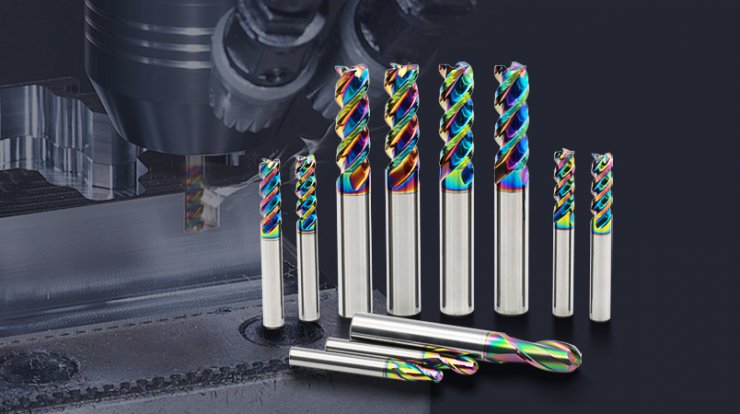
Solid Carbide DLC-coated end mills are specially designed for copper aluminum materials processing. It ensures good wear resistance and stable cutting performance in large feed cutting. High-strength anti-vibration, no sticking, smooth working surface. Achieving dry and wet machining, less tool changes with high efficiency.
UKO DLC Coating Carbide End Mills Includes:
- 4 Flute DLC Coating Carbide Square End Mills
- 4 Flute DLC Coating Carbide Square End Mills with U Shape Groove
- 2 Flute DLC Coating Carbide Ball Nose End Mills
- 4 Flute DLC Coating Carbide Corner Radius End Mills
- 4 Flute DLC Coating Carbide Corner Radius End Mills with U Shape Groove

 UKO has developed premium diamond-coated end mills for any challenges of machining graphite and composite material.
Cutting Diameter Range: 0.2-16mm.
Applicable Processing Materials: Graphite, Carbon Fiber Glass Fiber Composite Material, High-Silicon Aluminum, Dental Zirconia Oxide.
Product Features: Adopts nano-diamond composite coating technology and optimized cutter design, with excellent wear resistance and fracture resistance, high crystallinity, adhesion, and toughness. It can improve tool durability, achieve long-life processing and high-precision processing.
Types of End Mills
The two-edged milling cutter is specially used for keyway machining. It not only has better chip removal performance for keyway machining but also has the function of punching small batches and small processing volumes.
 |
||
 Slotting Slotting |
 Side Milling Side Milling |
 Shoulder Milling Shoulder Milling |
Ball nose end mills are widely used in various curved surfaces and arc groove semi-finishing and finishing processing. It has high temperature resistance, the maximum temperature to maintain cutting performance is 450-550/500-600 degrees Celsius. For more complex surface roughing, you can use 4-flute ball nose end mills.
 |
|||
 Contouring Contouring |
 Pocketing Pocketing |
 Profiling Profiling |
 Slotting Slotting |
It can do rough milling to remove a lot of blanks, and finely mill small chamfers on fine flat surfaces, relative to steep surfaces.
 |
||
 Profiling Profiling |
 R-Slotting R-Slotting |
 Side-R-Milling Side-R-Milling |
Why choose us?
We can manufacture and supply literally hundreds of both standard and custom-size solid carbide end mills and HSS end mills for most applications. Whether you need standard or non-standard end mills with flat, ball nose, or corner radius forms, or even micro end mills forms, We can turn your design into an end mill in just a few days.
Our milling cutter products are almost manufactured in 100% raw materials and strict processes, even in the harshest working conditions, we are the most advantageous milling cutter plant.
PDF Download

Resource
Since there are multiple options to combine particular tools and face milling operations, you may need some explanations on how to choose one. Here are some factors to pay attention to while making a decision:
Workload: Some types of face milling operations, like finishing with wiper inserts, suit the manufacturing of large batches of products better. It is correct only when the milling operations go with a combination of proper cutters. General face milling is an ideal option for mixes of small batches of components.
Your particular intent: For example, to remove large amounts of material rapidly and roughly or achieve the highest precision possible. Guide your choice accordingly.
Type of workpieces: In case you ordered castings, be prepared to apply for heavy-duty milling first. But if you have already prepared components, you can go with bare general face milling.
Design of a workpiece: It is highly inadvisable to mill over pre-drilled holes, for example. But the consistency of high feed machining consistency over the surface will severely deteriorate if applied to such a component. Heavy duty and general face milling are less demanding in this aspect.
Design of a finished component and technical requirements: It is frequent that you cannot achieve high precision by using, for example, heavy-duty or high feed milling. So be sure the chosen method meets the requirements set to the finished component’s design. Also, thin-walled components can be produced only by means of general face milling or finishing with wiper inserts (ineffective).
Material of a workpiece: Consider that high feed milling can be performed over the thick sheets of the durable metals by appropriate tooling. So, if you are unsure that a workpiece will withstand increased temperature and pressure, better go with general milling or finishing with wiper inserts.
You can make the decision regarding the choice of a face milling process alone. But do not forget to select an appropriate cutter with a sufficient entering angle as well as per their characteristics above.
Fast feed milling is a machining method that combines a shallow depth of cut with a high feed rate of up to 2.0 mm per tooth. This combination maximizes the amount of metal being removed from a part and increases the number of finished parts in a given time.
Indexable tools with a low-pressure angle of approx. 10°to 15° are often suitable for high-speed milling. Using a low-pressure angle reduces the chip thickness by up to 80 percent compared with tools with a 90° pressure angle. In this type of machining operation, feed rates per tooth (fz) of well over 1 mm are common. A further advantage of high-feed milling cutters is that the cutting forces flow almost entirely in the direction of the spindle. The result is minimal vibration during roughing operations with large overhangs.
A toric tool can imitate these effects. If the depth of cut (ap) is smaller than the cutting radius, the effective pressure angle decreases. The smaller the depth of cut, the more the distribution of forces shifts in the direction of the spindle.
Turning inserts shape symbol:

Turning inserts shape symbol T N M G:

Turning inserts shape symbol clearance angle:

Turning inserts inscribed circle diameter:

Turning inserts corner radius:

Turning inserts chip breaker and hole:
 Turning inserts thickness:
 The height between insert bottom and nose:

Carbide endmill is an industrial rotating cutting tool that can be used for milling operations, which is made from tungsten carbide (WC) and cobalt (Co) materials. They are also commonly referred to as a “carbide milling bit”. Center cutting end mill can be used for plunging operations (axial milling), and can also be used in side milling operations (radial milling). Non-center cutting bits may only be used in side milling applications.
The most common material used for end mills is tungsten carbide, but HSS (high speed steel) and Cobalt (high speed steel with cobalt as an alloy) are also available.
Aluminum-containing high-speed steel (HSS-Al) is smelted by a method of carbon (Al) elements based on molybdenum high-speed steel and is designed to increase thermal hardness and wear resistance.
The performance of the aluminum-containing high-speed steel is similar to the cobalt-containing ultra-hard high-speed steel, the hardness of the heat treatment is HRC67 ~ 69, the anti-bending strength is 290 kg / square millimeters, the impact value is 2.3~3kg 1m/cm² The high-temperature hardness at 600°C is HRC54~55.
Aluminum-containing high-speed steel (HSS-Al) forging performance and excellent cutting performance, but grinding performance is lower than normal high-speed steel when grinding with white jade wheels, and superior to high-speed steel and high vanadium high-speed steel and high vanadium Cobalt high-speed steel.
The durability of the HSS-Al tool is similar to the cobalt-containing ultra-hard high-speed steel, 1 to 2 times higher than the ordinary high-speed steel, up to 3 to 4 times.
Latest blog