
Wire Drawing Dies
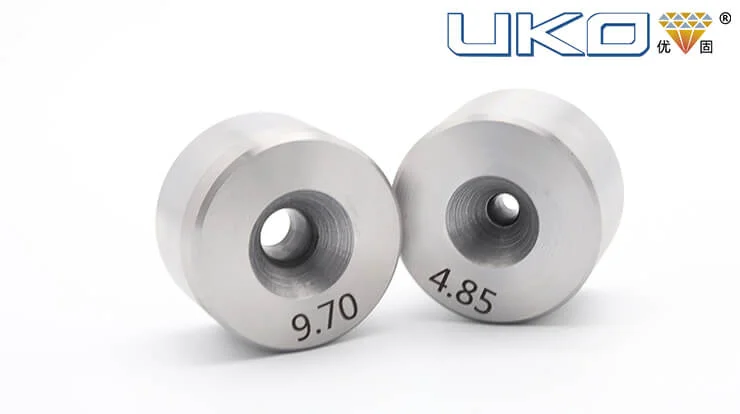
Wire drawing is a metalworking process used to reduce the cross-section of a wire by pulling the wire through a single, or series of, drawing dies. There are many applications for wire drawing, including high, medium and low voltage cables, automotive, medical wire, superconducting, bonding, and welding wires. Although similar in process, drawing is different from extrusion, because in drawing the wire is pulled, rather than pushed, through the die. Drawing is usually performed at room temperature, thus classified as a cold working process, but it may be performed at elevated temperatures for large wires to reduce forces. The wire dies we could supply are TC drawing dies, PCD wire drawing dies, Nano drawing dies, Diamond wire drawing dies and other Customised Dies.
Drawing dies are typically made of tool steel, tungsten carbide, or diamond, with tungsten carbide and manufactured diamond being the most common. For drawing very fine wire a single crystal diamond die is used. For hot drawing, cast-steel dies are used. For steel wire drawing, a tungsten carbide die is used. The dies are placed in a steel casing, which backs the die and allows for easy die changes. Die angles usually range from 6–15°, and each die has at least 2 different angles: the entering angle and the approach angle.
Category
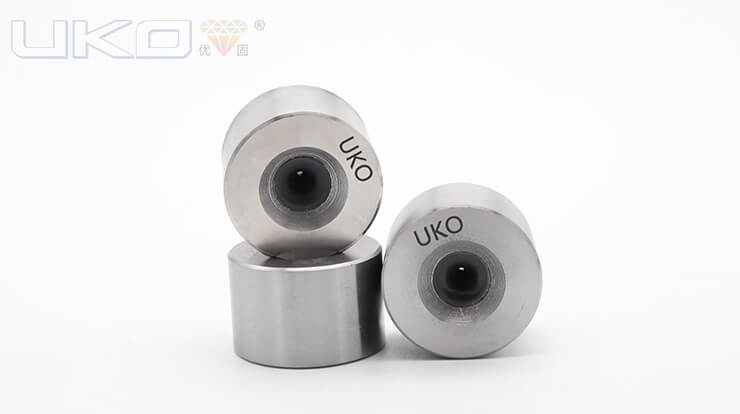
High quality carbide drawing dies of every size and specification. Wire Dies are produced according customer requirements in terms of size, drawing angle, bearing length and tolerances.
We can supply the sintered tungsten carbide nibs ,dies with inner polished, fully finished cased , tube or pipe drawing dies and rod and bar Drawing Dies.
Tube, or pipe, drawing dies can be round, hex or square as well as any custom shapes desired. The process is similar to the wire drawing process.
Bars and Rods are drawn in a similar fashion to wire, only they tend to be much thicker. A wide variety of metals are used for this purpose, including many steel and copper alloys.

| Case size(D * H)mm | Nib size (D * H)mm | Hole size mm | Tolerance range mm |
|---|---|---|---|
| 25*12 | 9*6 | 0.15~0.5 | 0~0.02 |
| 30*16 | 13*10 | 0.5~2.6 | 0~0.02 |
| 32*23 | 16*13 | 0.8~3.5 | 0~0.02 |
| 32*23 | 16*14 | 1.0~3.5 | 0~0.02 |
| 40*25 | 20*17 | 1.5~6.5 | 0~0.02 |
| 40*26 | 22*18 | 1.8~6.5 | 0~0.02 |
| 50*28 | 25*20 | 3.0~9.5 | 0~0.02 |
| 70*35 | 30*22 | 5.5~12.5 | 0~0.02 |
| 75*35 | 35*25 | 8.5~16.5 | 0~0.02 |
| 80*35 | 40*25 | 16.5~21.5 | 0~0.02 |
| 110*45 | 50*28 | 21.5~24.5 | 0~0.02 |
| 120*50 | 60*35 | 24.5~34.5 | 0~0.02 |
| 130*60 | 70*35 | 34.5~43.5 | 0~0.02 |
| 140*60 | 80*35 | 34.5~45.5 | 0~0.02 |
| 150*60 | 90*35 | 45.5~51.0 | 0~0.02 |
| 160*75 | 100*40 | 51.0~56.0 | 0~0.02 |
| 170*75 | 110*40 | 57.0~65.0 | 0~0.02 |
| 180*80 | 120*45 | 66.0~69.0 | 0~0.02 |
| 190*85 | 130*50 | 70.0~76.0 | 0~0.02 |
Polycrystalline Diamond (PCD) Dies for wire drawing that can be used for ferrous and non-ferrous wire drawing applications. Sizes are available for drawing applications ranging from ultra-fine wire to largely drawn rod,Hole Sizes:From 0.2500 mm to 14.0000 mm.
Drawing of polycrystalline diamond dies:

| Reduction Angles & Bearing Length of PCD Drawing Dies | ||||
| Metal Wire | Entrance Angle | Reduction Angle | Bearing length | Back Relief Angle |
| Copper Wire | 70°± 10° | 16°-18° | 30% ± 10 | 10°± 5° |
| Aluminium Wire | 70°± 10° | 18°-20° | 25% ± 10 | 10°± 5° |
| Stainless Steel | 60°± 10° | 12°-14° | 40% ± 10 | 10°± 5° |
| Brass Wire | 60°± 10° | 12°-14° | 30% ± 10 | 10°± 5° |
| Solder Wire | 70°± 10° | 16°-18°° | 30% ± 10 | 110°± 5° |
| GI Wire | 60°± 10° | 12-14° | 40% ± 10 | 10°± 5° |
| Tolerance and Case of PCD Wire Drawing Dies | ||||
| Diamter | Tolerance | Roundness | Case | |
| ≤0.020 | 0.0006 | 0.0030 | Ф25*6 | |
| 0.020-0.050 | 0.0006 | 0.0030 | Ф25*8 | |
| 0.051-0.100 | 0.0010 | 0.0050 | Ф25*8 | |
| 0.101-0.200 | 0.0010 | 0.0050 | Ф25*8 | |
| 0.201-0.500 | 0.0015 | 0.0080 | Ф25*8 | |
| 0.501-1.000 | 0.0020 | 0.0010 | Ф25*10 | |
| 1.001-1.500 | 0.0025 | 0.0013 | Ф25*12 | |
| 1.501-2.200 | 0.0030 | 0.0015 | Ф25*14 | |
| 2.201-3.300 | 0.0040 | 0.0020 | Ф28*16 | |
| 3.302-4.600 | 0.0050 | 0.0025 | Ф28*16 | |
| 4.601-5.500 | 0.0060 | 0.0030 | Ф43*26 | |
| 5.501-8.00 | 0.0080 | 0.0040 | Ф43*30 | |
The nano-diamond composite coating drawing dies is based on cemented carbide (WC-Co) as the substrate, and chemical vapor deposition (CVD) is used to apply micro-level and nano-level diamond composite coating on the surface of the inner hole of the die. After precision grinding and polishing of the coating, a new mold is obtained.
The micro-nano composite coating on the surface of the inner hole not only has the characteristics of strong adhesion and good wear resistance of the micron diamond coating but also has the advantages of high surface finish of the nano-diamond coating, small friction coefficient, and easy grinding and polishing.
There is a huge amount of raw material and money to be saved or lost in the stranding and compacting operations of energy cable manufacture. Using Nano drawing dies equates to maximum operational savings and minimum loss of materials. Many cable manufacturers have found replacing tungsten carbide wire drawing dies with CVD coating drawing dies has resulted in significant raw material savings.
Example Compacting Profile Notes:

Our product advantages:
- Targeted pre-treatment process: make the coating and the substrate tightly combined
- Bottom micron diamond coating: excellent wear resistance
- Surface layer nanometer diamond coating: excellent surface finish and low friction coefficient
- Computer simulation to optimize the hole design: make the force of the wire evenly
- Life: drawn aluminum wire is more than 30 times that of tungsten carbide dies; drawn low carbon steel wire is more than 20 times of T.C drawing dies; drawn medium carbon steel wire is more than 30 times of carbide dies.
- Aperture change when the mold is scrapped: 0.00 mm, free of drawing dies repair
- The working surface has a high finish and is always the same
- High dimensional accuracy
- Reduce the number of shutdown inspections and drawing dies changes, and improve production efficiency
- It saves raw materials, and the length of the metal wire produced is 1% to 2% longer than that produced by traditional drawing dies.
- Improve product quality (because the working surface has high smoothness and high dimensional accuracy)
Natural monocrystalline diamond is the hardest known material, almost twice as hard as the cubic boron nitride. Approximately 6% of the rough natural diamond is suitable for the production of drawing die.
The diamonds are thoroughly inspected before they are flattened, then the same are inserted in a stainless steel case that is later mounted by a heating process. Our diamond dies are widely accepted for fine wire drawing.
ND dies enable long drawing die life with long lasting dimensional tolerances, even for high demanding applications. UKO ND drawing dies are manufactured with a mirror polish and a smooth wire entry to ensure optimal die life and string-up.
Standard Casing Size for ND Dies are 25mm x 8mm or 25mm x 10mm,diamond dies from a size range of 0.050mm to 1.000mm.
Natural Diamond Drawing Dies (ND):
| Die Sizes | Production in Metric Tons (MT) | |||
| 0.4448, 0.3954, 0.3522, 0.32021 | 45/50 MT each die | |||
| 0.2914, 0.2646, 0.2957, 0.286 | 45/50 MT each die | |||
| 0.2406, 0.2241, 0.2046 | 45/50 MT each die | |||
| 0.187 | 45/50 MT each die | |||
Suitable Drawing for Your Usage:
| mm | Inches | ND drawing dies | PCD drawing dies | TC drawing dies |
| 0.012-0.049 | 0.0005-0.0019 | ★ | ||
| 0.050-0.099 | 0.0019-0.0039 | ★ | ||
| 0.100-0.599 | 0.0039-0.0236 | ★ | ★ | ★ |
| 0.600-2.099 | 0.0236-0.0826 | ★ | ★ | ★ |
| 2.1-15.9 | 0.0827-0.6260 | ★ | ★ | |
| 16.0-35.0 | 0.6260-1.3780 | ★ |
All shaped profile dies are custom made to your specific requirements out of extremely high wear-resistant tungsten carbide material.
Wire Shapes:Square,Rectangular,Triangular,Flat,Oval,Half round,Hexagonal,also we could supply tungsten carbide groove dies and sprial groove dies for concrete nails.
Tungsten carbide wire guides bushes and wire guide dies for straightening machines and electrodes nozzles of various grades and sizes, Material supplied rough or finished and polished.
Our technicians will guide you towards the dies suited to your various usage.
Size of tungsten carbide wire guide dies:

| Dimension (mm) | R | ||
| D(mm) | H (mm) | d(mm) | |
| 8.0 | 15.0 | 3.0 | 7.0 |
| 13.0 | 10.0 | 7.0 | 3.6 |
| 13.9 | 10.0 | 8.0 | 4.4 |
| 15.0 | 10.0 | 10.0 | 5.4 |
| 17.0 | 10.0 | 12.0 | 3.0 |
| 22.0 | 18.0 | 8.0 | 5.0 |
| 22.0 | 18.0 | 10.0 | 7.5 |
| 22.0 | 18.0 | 12.0 | 7.5 |
| 28.0 | 30.0 | 15.0 | 10.0 |
| 30.0 | 20.0 | 18.0 | 15.0 |
| 30.0 | 20.0 | 12.0 | 15.0 |
| 35.0 | 35.0 | 18.0 | 10.0 |
| 40.0 | 50.0 | 25.0 | 15.0 |
| 40.0 | 35.0 | 20.0 | 12.0 |
| 45.0 | 50.0 | 30.0 | 15.0 |
| 45.0 | 50.0 | 28.0 | 15.0 |
| 45.0 | 35.0 | 24.0 | 12.0 |

Resource
 |
PCD wire drawing dies regular specification |
|
Wire drawing lubricant powder products |
|
Wire drawing dies product parameters |

Wire drawing powder, also called wire drawing lubricant powder, is usually divided into calcium-based and nano-based. In the process of wire cold drawing deformation, wire drawing powder can play a lubricating role, reduce friction, reduce energy consumption, and prolong the service life of wire drawing die. In the drawing process, a lubricating film can also be formed on the surface of the steel wire, which can protect the steel wire.
Wire manufactures have different processes, the type of wire drawing machine may in “water cooling”, “air cooling”, “straight-in” or “pulley drawing” type. The drawing speed, the quality of the wire drawing dies, the material of the drawn wire, the finished wire, steps of drawing dies all require different wire drawing lubricant powder. So some drawing processes use 2 or 3 types of drawing powder, some even need to match a new material in use.

Depending on request of wire drawing , die box or micro-cassette type machine production is carried out in different steel qualities and taking into consideration wire input-output diameters.
Up to 16,00 mm of wire rod can be used and 0,80 mm wire can be produced and 35 m / sec speeds can be achieved.
Our carbide wire drawing dies,PCD wire dies,CVD coating dies and natural diamond dies could complatible with any brand of wet drawing machine.
WET DRAWING MACHINES

Net drawing machines could be used for Low carbon steel and galvanized steel with tungsten carbide wire drawing dies in YG6/YG8,Also used for Steel Cord wires.
Application of Wire Drawing Dies

- Low carbon steel
- High carbon steel
- Stainless steel
- For welding wire
- Aluminium
- Nickel-chromium-molybdenum alloy
- Wire for tire: Steel cord and suw wire diameter from 0.1 to 2.00 mm
Overview
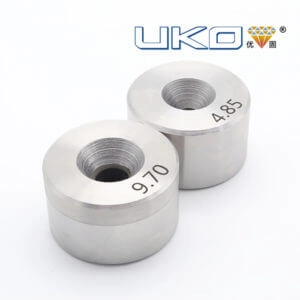
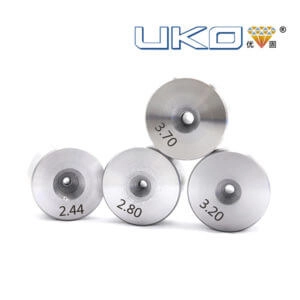
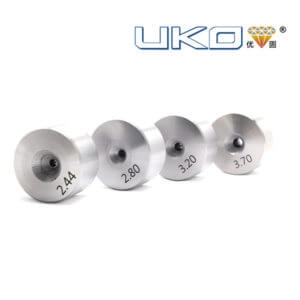
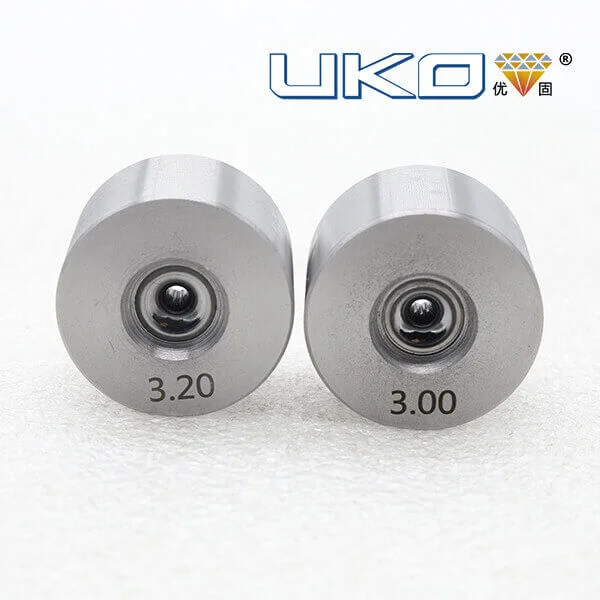
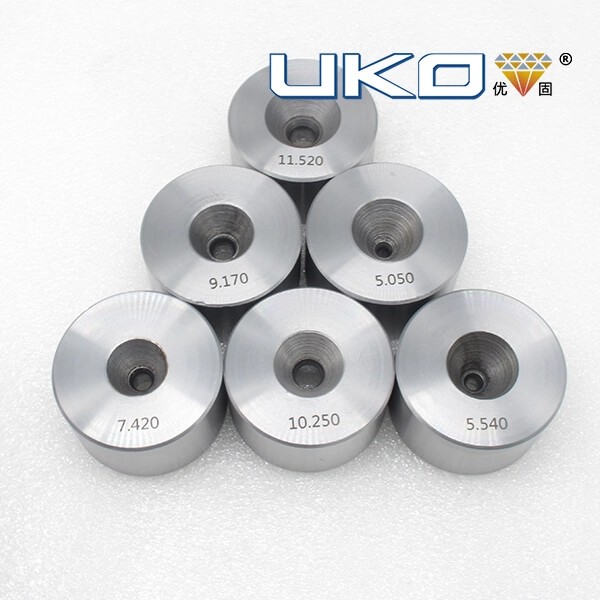
In order to ensure high-quality wire and effectively control the cost of wire drawing dies, attention should be paid to the following aspects:
1. Ensure smooth operation of wire drawing equipment. The wire drawing drums and wire guide wheels should be smooth and flexible, and their run-out tolerances should be strictly controlled. If it is found that the drum and guide wheel have worn grooves, they should be repaired in time. Good lubrication conditions are important conditions to ensure the surface quality of the wire and extend the life of the mold.
Always check the lubricating strength index to remove the copper powder and impurities in the lubricating oil so that it will not contaminate the equipment and die holes. If the lubrication fails, the lubrication system must be replaced and cleaned in time.
2. Reasonable collocation of molds is the key element to ensure the surface quality of the wire rod, control the dimensions accurately and consistently, reduce the wear of the wire drum and reduce the operating load of the equipment. For the sliding wire drawing machine, it is necessary to be familiar with the mechanical elongation of the equipment and choose the sliding coefficient reasonably, which is the first step of mold matching.
The hole type of the mold is selected according to the material of the wire to be drawn and the area reduction rate of each wire drawing. Generally speaking, the harder the wire is drawn, the smaller the compression angle of the mold and the longer the sizing area; and vice versa.
The area reduction rate of each wire drawing is also closely related to the compression angle of the corresponding mold. The compression angle should be adjusted appropriately according to the size reduction rate.
3. Effective maintenance and repair of molds is essential to reduce the cost of wire drawing. Due to the vibration of the wire, a slight ring abrasion first occurred in the area contacting the wire in the compression zone of the drawing die, and then continued to expand to the sizing area, resulting in a serious decrease in the surface quality of the wire and an increase in the wire size.
Not only that, severe wear and tear will cause lateral cracks (mainly in the drawing of soft filaments) or longitudinal cracks (mainly in the drawing of hard filaments), so that the drawing die is scrapped prematurely. Therefore, it is necessary to scientifically formulate wire drawing die maintenance specifications according to the type of wire to be drawn and the characteristics of the wire drawing machine.
Under normal circumstances, slight annular wear only needs to be polished to re-use, or a slightly enlarged diameter can also meet the drawing requirements. Excessive wear will greatly reduce the number of mold repairs, and even scrap, making the cost of wire drawing increased.
Why Is the Drawing Die the Basis of Drawing Die Quality?
The drawing die is a mold for manufacturing metal wire, which is processed from coarse to fine, and gradually reaches the required size. This special mold is what we call today. Next, we will learn more about the specific use of the product.
The products produced by the wire drawing die are widely used in the fields of TV radar, instrumentation and aerospace. Therefore, related products and various aluminum alloys are made of ordinary drawing dies, diamond drawing dies, and PCD wire drawing dies.
At the same time, natural diamond as a raw material has strong wear resistance and a long service life.
The pipe production process includes several process steps of lamination, die drawing and turning. The products are divided into different varieties and have a wide range of uses.
With the continuous development of society, the quality and efficiency of this product are also constantly improving.
There is room for development in the process of adaptation. In addition, in terms of material selection and processing technology, the product has more advantages.
Therefore, it has a wide range of uses and brings great help to our lives. The above drawing die is the basis of drawing quality.
What Are the Factors That Affect the Service Life of Wire Drawing Dies?
The service life of TC Dies will not only affect the production cost but also affect the stability of product quality and production efficiency.
What factors will affect the service life of the drawing die?
- The Influence of the Production Materials on the Service Life of the Drawing Die
The mold material is one of the important factors that affect the service life of the mold. The performance of various mold materials in terms of hardness, corrosion resistance, wear resistance, fracture resistance, plastic deformation resistance, cold and hot fatigue resistance, etc. are very different, so the performance of the mold material should meet the specific conditions for the use of wire drawing dies. Otherwise, it will inevitably cause the early failure of the mold.
- The Effect of the Hole Structure on the Service Life of the Drawing Die
With the improvement of modern drawing technology, traditional mold design concepts are changing. New concepts have been introduced into modern mold design. New “straight” drawing dies are increasingly replacing traditional “arc” drawing dies. After a series of improvements, the service life of the linear drawing die is 3-4 times higher than that of the arc drawing die, and it is especially suitable for high-speed drawing.
- The Influence of the Production Process on the Service Life of the Drawing Die
During the manufacturing process of wire drawing dies, multiple processes such as forging, machining and heat treatment are required. If the manufacturing process of any process is unreasonable, it may be that the performance of the mold steel is reduced, structural defects are formed, and the hidden dangers of early mold failure are generated.
- The Influence of Working Conditions on the Service Life of the Drawing Die
The processed materials with different thicknesses and different materials have a great influence on the service life of the drawing die. The greater the strength and thickness of the processed material, the greater the force the mold needs to withstand, and its service life is relatively low. If the processed material and the mold material have a greater affinity, there may be adhesion and wear with the mold during the molding process, resulting in a reduction in the service life of the mold.
- The Influence of Reasonable Use and Maintenance of Wire Drawing Die on Its Life
During the use of the drawing die, it is reasonably used to maintain the drawing die and improve the repair level of the die. It is an important way to extend the service life of the die. In addition, good lubrication can effectively reduce friction and friction heat. Thereby reducing mold wear and improving the service life of wire drawing mold.
1.Usually refers to various molds for drawing metal wires, as well as drawing dies for drawing optical fibers. The center of all drawing dies has a certain shape of hole, round, square, octagonal or other special shapes. When the metal is pulled through the die hole, the size becomes smaller and even the shape changes. Steel molds are sufficient when drawing soft metals (such as gold and silver). The steel molds can have multiple holes with different diameters.
The drawn steel wire (steel wire) generally uses a cemented carbide mold (Tungsten carbide nib). The typical structure of this mold is a cylindrical (or slightly tapered) cemented carbide core tightly embedded in a round steel sleeve. In the (case), the inner hole of the core includes a bell radius, an entrance angel, an approach angle, a bearing, and a back relief. For drawing non-ferrous metal wires, such as copper and aluminum, wire drawing dies similar to wire dies are also used. The shape of the inner hole is slightly different. The fine wire can be used for polycrystalline dies (man-made diamonds), and also for natural diamond.
Some of the soldiers in the ancient Chinese terracotta warriors and horses of Qin Shihuang could see metal wires on the stone armor, so it is estimated that someone had mastered the drawing technique at that time. In the Ming Dynasty book of Tiangong Kaiwu, we can see the needle making process, among which the drawing die is used.
First, the definition of drawing die
Usually refers to various molds for drawing metal wires, as well as drawing dies for drawing optical fibers. The center of all drawing dies has a certain shape of hole, round, square, octagonal or other special shapes. When the metal is pulled through the die hole, the size becomes smaller and even the shape changes.
Second, the type of drawing die
1. Steel molds—Steel molds are sufficient when drawing soft metals (such as gold and silver). There can be multiple holes with different apertures on the steel mold.
2. Cemented carbide mold—Tungsten carbide nib is generally used for drawing steel wire (steel wire). The typical structure of this mold is a cylindrical (or slightly tapered) cemented carbide core. The ground is embedded in a round steel case (Bell radius), entrance angel (Entrance angel), deformation angle (approach angle), sizing belt (bearing) and Exit angle (back relief).
3. Wire molds—For drawing non-ferrous metal wires, such as copper and aluminum, wire drawing dies similar to wire dies are also used. The shape of the inner hole is somewhat different.
4. Polycrystalline mold-Polycrystalline mold (man-made diamonds) can be used for drawing thin wires, as well as wire-drawing molds using natural diamonds.
Third, the use of drawing die
The wire drawing die is a very important consumable die for drawing wires by various metal wire manufacturers (such as wire and cable factories, steel wire factories, welding wire factories, etc.). The scope of application of wire drawing die is very wide. It is mainly used for drawing linear and difficult-to-machine objects such as bars, wires, wires, pipes, etc. It is suitable for drawing processing of metal and alloy materials such as steel, copper, tungsten, molybdenum, etc.
Since the cost of the wire drawing die accounts for more than 1/2 of the wire drawing cost, how to reduce the cost of the wire drawing die and increase its service life is an urgent issue for metal wire production units.
In order to improve the production competitiveness of foreign metal products industry, more and more attention is paid to the improvement of the quality of the drawing die and the manufacturing process. Starting from the improvement of the life of the drawing die, the material, structure, manufacturing process, manufacturing equipment and testing instruments of the drawing die have been studied. Systematic research has developed composite drawing dies, new drawing die materials, new surface coating technologies, and new hole design methods for drawing dies, which have promoted the development of wire drawing production in the world.
China is a major wire producer and its output ranks among the highest in the world. China’s wire drawing die manufacturing industry has developed rapidly since the 1980s. With the continuous improvement of wire drawing die manufacturing level and continuous improvement of production technology, China’s wire drawing die manufacturing technology has further developed, especially in the materials of wire drawing die, Great progress has been made in such areas as structure. But in general, there is still a big gap with foreign countries. Although the types of wire drawing dies produced abroad are similar to those of domestic ones, the materials and processes used are more advanced. The processing accuracy, durability and wear resistance of wire drawing dies are better than those of our products. Therefore, strengthening the management of mold making, improving the quality level of wire drawing dies, and promoting the progress of mold making technology are important issues currently facing the mold making industry.
2. Drawing die material
After decades of development, many new wire drawing die materials have appeared. According to the type of material, the wire drawing die can be divided into alloy steel die, hard alloy die, natural diamond die, polycrystalline diamond die, CVD diamond die and ceramic die. In recent years, the development of new materials has greatly enriched the application range of wire drawing dies and increased the service life of wire drawing dies.
(1) Alloy steel mold is an early material for wire drawing die manufacturing. The materials used to make alloy steel molds are mainly carbon tool steel and alloy tool steel. However, due to the poor hardness and abrasion resistance of the alloy steel mold, and the short life, it cannot meet the needs of modern production, so the alloy steel mold was quickly eliminated, and almost no alloy steel mold can be seen in the current production process.
(2) The cemented carbide mold is made of cemented carbide. Cemented carbide is a tungsten-cobalt-based alloy whose main components are tungsten carbide and cobalt. Tungsten carbide is the “skeleton” of the alloy, which mainly plays a hard and wear-resistant role; cobalt is the bonding metal and the source of alloy toughness. Therefore, compared with alloy steel molds, cemented carbide molds have the following characteristics: high wear resistance, good polishing, small adhesion, low friction coefficient, low energy consumption, high corrosion resistance, these characteristics make the carbide wire drawing Die has a wide range of processing adaptability, and has become the most widely used wire drawing die mold.
(3) Natural diamond is an allotrope of carbon, and the mold made with it has the characteristics of high hardness and good wear resistance. However, natural diamond is relatively brittle and difficult to process. It is generally used to make wire drawing dies with a diameter of 1.2 mm or less. In addition, natural diamond is expensive and scarce in supply, so natural diamond molds are not the economical and practical drawing tools that people eventually seek.
(4) Polycrystalline diamond is made by carefully selecting high-quality artificial diamond single crystals with a small amount of binders such as silicon and titanium, and polymerizing under high temperature and pressure conditions. Polycrystalline diamond has high hardness and good abrasion resistance. Compared with other materials, it has its own unique advantages: due to the anisotropy of natural diamond, during the drawing process, when the entire hole is surrounded by Under working conditions, natural diamond will wear preferentially at a certain position of the hole;
Polycrystalline diamond is polycrystalline and has the characteristics of isotropy, thereby avoiding uneven wear of mold holes and out-of-round mold holes. Compared with cemented carbide, the tensile strength of polycrystalline diamond is only 70% of common cemented carbide, but 250% harder than cemented carbide. In this way, polycrystalline diamond mold has more advantages than cemented carbide mold. . The wire drawing die made of polycrystalline diamond has good wear resistance, uniform bore wear, strong impact resistance, high wire drawing efficiency, and the price is much cheaper than natural diamond. Therefore, polycrystalline diamond dies are currently widely used in the wire drawing industry.
(5) CVD (chemical vapor deposition) coating wire drawing die is a newly developed new technology. The main method is to coat the diamond film on the carbide wire drawing die. Diamond film is a pure diamond polycrystal. It has the advantages of single crystal diamond’s smoothness and temperature resistance, as well as the abrasion resistance and low price of polycrystalline diamond. It has achieved good results in preparing wire drawing tools instead of rare natural diamond. Effect, its widespread use will bring new vitality to the wire drawing industry.
(6) High-performance ceramic materials have the characteristics of high hardness, good abrasion resistance, strong chemical stability, high-temperature mechanical properties, and difficulty in bonding with metals. They can be widely used in the processing of difficult-to-process materials.
Wire drawing die is a very important consumable product used by various metal wire manufacturers to draw wires. The application range of metal wire drawing dies is very wide, mainly used for drawing straight and difficult-to-machine objects such as bars, wires, pipes, etc., and generally suitable for drawing processing operations of metal and alloy materials such as steel, copper, tungsten, molybdenum, etc. Since the cost of the carbide wire drawing die can reach more than 1/2 of the wire drawing cost, how to reduce the consumption cost of the wire dies and increase its service life has become the primary problem.
We shall discuss this problem today.
1.The wire used for drawing must be pretreated.
(1)Surface pretreatment:
The wire with dirty surface and impurities should be cleaned and dried before drawing;
Wires with a lot of oxide scale on the surface must be acidified and dried before drawing;
For wires with peeling, pits, heavy leather, etc. on the surface, they must be polished by a grinder and then drawn;
(2) Heat treatment: For wires with excessive hardness or uneven hardness, the hardness should be reduced by annealing or tempering first, and the wire can be drawn after maintaining good hardness uniformity.
2.Maintain a proper drawing surface shrinkage rate
Cemented carbide wire drawing dies have the characteristics of being hard and brittle. If they are used for shrinking drawing with large area shrinkage, it is easy to cause the die to bear the stress and easily break and scrap.
Therefore, we should select the appropriate area shrinkage for drawing according to the different mechanical properties of the wire.
Generally, the single-pass surface shrinkage rate should not exceed 20% when using tungsten carbide wire guide dies to drawing the stainless steel wire.
3. Use lubricants with good lubricating properties
During the drawing process, the quality of lubricant or wire drawing powder and the supply of wire-drawing lubricants all affect the service life of the drawing die. Therefore, the lubricant is required to have a stable oil base, good oxidation resistance, excellent lubricity, cooling and cleaning properties, and always maintain the best lubrication state throughout the production process.
During use process, we should observe the condition of the lubricating oil constantly. If severe discoloration or increase of metal powder in the lubricating oil is found, it should be replaced or filtered in time to avoid the lubricating performance of the lubricating oil from being degraded due to oxidation, and to avoid the small particles falling off during the drawing metal particles damage the mold.
4. Regular maintenance and repair of drawing dies
In the process of long-term use of the wire drawing TC dies, the die wall is subjected to strong friction and erosion of the metal wire, which will inevitably produce abrasion. The most common one is the annular groove (dent) at the wire entrance in the working area.
If it is not replaced in time for repair, the ring groove will continue to expand rapidly, making repair more difficult, and there may even be cracks in the deeper part of the ring groove, causing the mold to be completely broken and scrapped.
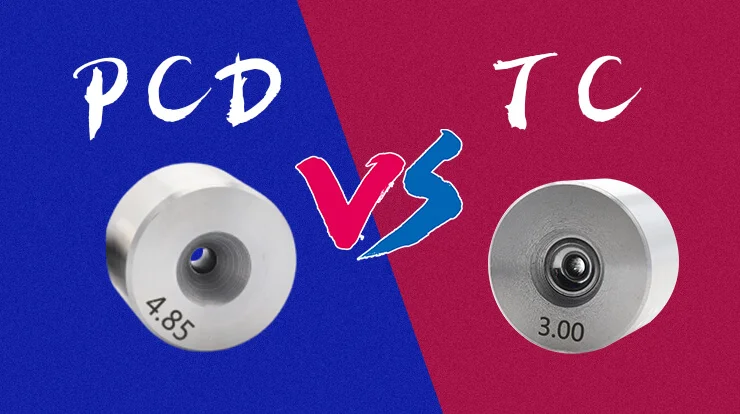
PCD is commonly known as the “artificial diamond”, PCD is a top-quality material for wire drawing dies. Its working life is 15-25 times the working life of tungsten carbide dies so that improving efficiency and saving cost for users.
Polycrystalline Diamond (PCD) Wire Drawing Dies that can be used for a wide range of drawing applications. PCD Dies offer a high resistance to wear and an excellent wire surface finish. The dies can be used in ferrous and non-ferrous wire drawing applications.
What kinds of drawing die core materials?
The drawing core is the core component of the diamond wire drawing die, which can be divided into a PCD (polycrystalline diamond) Core, CVD Diamond Core, and Single-crystal Diamond Die Core three categories.
- PCD Core
The common brushed core models in the market include SD, CXD, and CXT series. The success of PCD has brought great changes to the wire draw industry, which makes the entire processing process more efficient and stable. The PCD is sintered by the micrometer diamond particles and the binding agent to be sintered under high temperature and high-pressure conditions, the hardness is high, the wear resistance, the impact resistance is strong, and the advantages of uniform wear and long life during the mold use are applicable. High-speed draws. Since the PCD presents isotropic in macro, it does not occur like a single crystal diamond and a phenomenon of unevenness and the phenomenon of the mold hole. In addition, since the price of PCD is much lower than that of single-crystal diamonds, it has been widely used in the brushed industry. Most diamond drawings are used using a PCD brushed mold. The PCD core can be divided into cobalt-based and silicon groups. The cobalt-based PCD core contains a metal-binding agent, which has good processability, can be processed using a process of an electric spark, laser, ultrasonic wave, but the presence of cobalt makes diamonds easy to occur in high temperatures, so the core is Suitable for processing and use under conditions below 650 degrees Celsius. The silicon-based PCD core processability is relatively poor, but there is no metal-binding agent in the material, and thus the material can still maintain good thermal stability under 1000 degrees Celsius.
- CVD Diamond Core
CVD diamonds are also known as chemical vapor deposition diamonds, which are carbon-containing gas under high temperature and low-pressure conditions, depositing pure diamonds grown on the surface of the solid substrate. The CVD diamond has high hardness, good wear resistance, low friction coefficient, high surface finish, can be made of 0.02-1.0mm aperture drawing, for drawing stainless steel wire, tungsten wire, molybdenum wire, copper wire, aluminum wire, etc. Since the CVD diamond does not contain any binding agent, the CVD diamond brushed mold exhibits higher abrasion resistance, corrosion resistance, thermal conductivity, and thermal stability compared to the PCD. The disadvantage of this product is that its toughness is not as good as PCD, weak impact resistance, cracking, and brushed mold preparation is also strict than PCD.
- Single Crystal Diamond Core
The single-crystal diamond has a high hardness and excellent wear resistance. The surface of the wire is tapered is high, but since the structure has an anisotropy, the hardness is also anisotropy, so that the wear of the mold hole is not Uniform, the product is not round, and the resources are rare, the price is expensive, and the fine line drawing die or finished drawing die is generally used as a high surface quality requirement. The single-crystal diamond brushed core is divided into two types: natural diamond brushed mold and artificial single-crystal diamond brushed mold core.
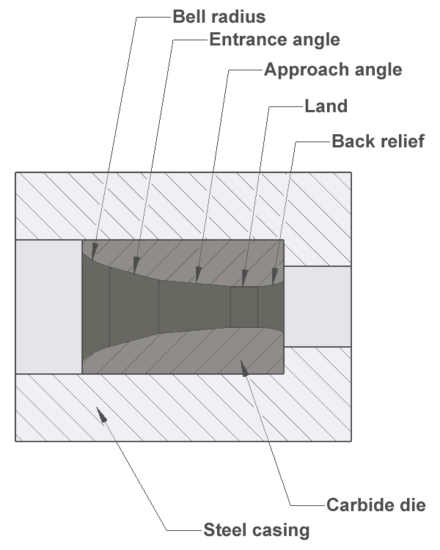
The structure of the wire drawing dies core can be divided into five sections according to the nature of the work:
- Bell Radius: It is convenient to thread and prevents the wire from scratching the drawing dies from the entrance direction.
- Entrance Angle: Through it, the steel wire can be easily brought into the lubricant.
- Approach Angle: The main part of the die hole, where the deformation process of the steel wire is carried out, that is, the original section is reduced to the required section size.
- Land: Its function is to obtain the exact size of the drawn wire.
- Back Relief: Used to prevent the steel wire from being unsteady and scratching the surface of the steel wire.
The inner diameter profile of the drawing dies is very important, it determines the tension which is required to compress the wire and affects the residual stress in the wire after drawing.
With the increase of the wire drawing speed, the service life of the wire drawing dies has become a prominent problem. Americans T Maxwall and E G Kennth proposed a new wire drawing dies hole pattern theory suitable for high-speed wire drawing, that is, the “straight line” theory. The wire drawing dies made according to this theory has the following characteristics:
- The entrance area and lubrication area are combined into one, which has a tendency to reduce the lubrication angle so that the lubricant is subjected to a certain pressure before entering the working area, so as to achieve a better lubrication effect.
- The entrance area and working area are lengthened to establish a better lubrication pressure, and the angles are optimized according to the drawing material and the compression rate of each pass.
- The sizing area must be straight and reasonable in length.
- The vertical line of each part must be straight.
Latest blog