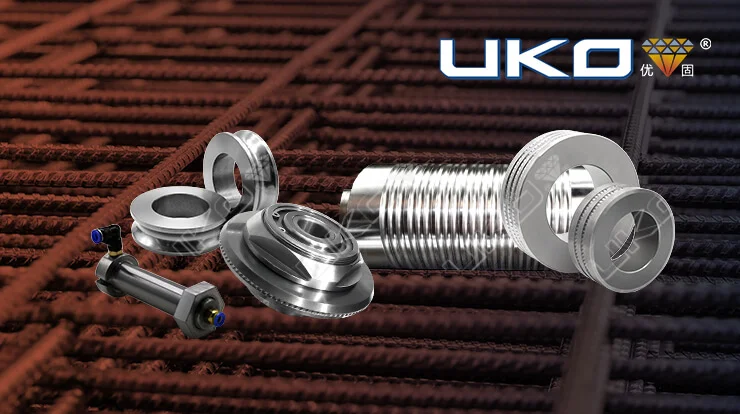

Hot Rolling Roller & Cold Rolling Roller
Tungsten carbide roller (T.C. rolls or TC rollers) are used in the manufacture of mill rolls & wire flattening for extended life in applications where long rolling campaigns are required. Their extreme hardness makes them suitable for wire rods finishing blocks and some shaping applications. Carbide roller required by steel mills. It is mainly divided into two categories: high- speed wire rod mill rolls, and carbide cold rolls 3 dimension carbide rolls.
Mill Roll is the main working component and tool of the rolling mill, and the use is to make the metal continuously plastic deformation. The mill roll is mainly composed of a roll body, a roll neck, and a shaft head, three parts. The mill roll can be arranged in two rolls, three rolls, four rolls, or multi-rolls in the housing.
Tungsten carbide rolls body is actually involved in the intermediate working portion of the rolling metal (MAT.: Tungsten Carbide). It has a smooth cylindrical or rolled groove. T.C rolls neck is mounted in the bearing and the rolling force is transmitted to the housing through the Pillow Block and the Screwdown Device. The transmission end shaft head is connected to the Pinion Stand by the connecting shaft, and the rotational torque of the motor is transferred to the solid carbide rolls.
Category
Tungsten carbide cold rolls ( carbide cold rolls ), also in name wire mesh rolls, tungsten carbide rolls, which are used in cold rolling steel wire into reinforcing wire for the construction industry. TC cold roll includes PR, CA, RT, RO, FO type.
Tungsten carbide rolls in types:
- Profiling rolls
- Oval reducing rolls
- Round reducing rolls
- Forming rolls
- Sizing rolls

Grade and specification of tungsten carbide wire rolls:

| Grade | Wc content | Co Content | TRS | Density | Hardness |
| % | % | N/mm2 | G/Cm3 | HRA | |
| YG15 | 85 | 15 | ≥2020 | 13.9-14.1 | ≥86 |
| YGH30 | 85 | 15 | ≥2700 | 14.02 | ≥84.9 |
Standard tungsten carbide roll dimension:
| Outside diameter in mm | Inside diameter in mm | Thickness in mm | |||
| 123 | 82 | 15 | |||
| 123 | 82 | 20 | |||
| 125 | 82 | 15 | |||
| 125 | 82 | 20 | |||
| 140 | 90 | 15 | |||
| 140 | 90 | 20 | |||
| 150 | 90 | 15 | |||
| 150 | 90 | 20 | |||
| 160 | 90 | 15 | |||
| 160 | 90 | 20 | |||
| 170 | 100 | 20 | |||
| 220 | 130 | 20 |
Cold rolling sequences – reinforcing wire:

Cold rolling sequences – smooth wire:

Applications:
Rebar (short for reinforcing bar), known when massed as reinforcing steel or reinforcement steel, is a steel bar used as a tension device in reinforced concrete and reinforced masonry structures to strengthen and aid the concrete under tension.
Our tungsten carbide rolls are used to produce smooth or ribbed wire for the construction field.

UKO manufactures rolling mill rolls for finishing blocks or to be mounted in rolls for use in intermediate, pre-finishing, and finishing stands.
Wire and rods are hot-rolled between two rolls. Work material deforms and achieves the desired shape and size of the wire or rod. During the process of rolling, these rolls are subjected to severe thermo-mechanical fatigue in addition to wear.
Billets are rolled into wire/rod through multiple pass rolling: Roughing Stand, Intermediate Stand, Block Mill and Finishing Stand.
Our tungsten Carbide rolls for wire rod rolling could provide excellent quality on the rolled material and minimize the downtime.
The type of tungsten carbide rings we could be supplied are Intermediate & Pre-Finishing (Cantilever) Stand Rolls,Composite cemented carbide roll rings,KOCKS tungsten carbide rings.
Grade and properties of carbide rolls rings:
| Grade | Chemical composition | Physical properties | |||
| Co % | WC % | Hardness HRA | Density g/cm3 | Transverse rupture strength | |
| (Sample B) MPa | |||||
| YGH30 | 15 | 85 | 83.5 | 13.90-14.10 | 2520 |
| YGH40 | 18 | 82 | 83 | 13.60-13.80 | 2570 |
| YGH45 | 20 | 80 | 82 | 13.45-13.65 | 2570 |
| YGH55 | 26 | 74 | 81 | 12.90-13.10 | 2570 |
| YGR30 | 15 | 85 | 83 | 13.98-14.18 | 2360 |
| YGR40 | 18 | 82 | 82 | 13.60-13.80 | 2400 |
| YGR45 | 20 | 80 | 80.5 | 13.45-13.65 | 2250 |
| YGR55 | 25 | 75 | 79 | 13.00-13.20 | 2400 |
| YGR60 | 30 | 70 | 78.5 | 12.60-12.80 | 2200 |
Recommended applications of grade for tungsten carbide rings:
- Rolling mills with reducing & sizing mill

- Rolling mills without reducing & sizing mill

| Grade | Recommended applications | ||||
| YGH30 | Moderate wear resistance and impact resistance, good for general purposes. Used in the last 1-4 stands or all stands of finish rolling mills. | ||||
| YGH40 | Best for general purposes. Used in the front stands of good mills and in the rear stands of common mills. | ||||
| YGH45 | Used in the first and second stands of finish rolling mills and in the stands of prefinish rolling mills. For every stand of the rolling lines for low speed rolling, low precision and unstable operation. | ||||
| YGH55 | Maximal binder content in YGH series, good toughness and crack resistance. Used in the stands of prefinish rolling mills and for roll rings for hot rolling screw thread steel. | ||||
| YGR30 | Good toughness, wear resistance, corrosion resistance and crack resistance. Used in the middle and rear stands of finish rolling mills. | ||||
| YGR40 | Good toughness and thermal crack resistance, good for general purpose. Used in most stands of the finish rolling mills and in the rear stands of common mills. | ||||
| YGR45 | Good toughness and thermal crack resistance. Used in the front stands of finish rolling mills. | ||||
| YGR55 | Good impact resistance. Used in the stands of prefinish rolling mills for hot rolling screw thread steel bars and they can be machined with turning and milling. | ||||
| YGR60 | Good impact resistance and toughness. Used for hot rolling screw thread steel bars and in the first and second stands of prefinish rolling mills. | ||||
Size range of tungsten carbide mill rolls:
| OD(mm) | ID(mm) | T(mm) | |||
| 145-450 | 87-280 | 62-210 |
Roller Holder matching Tungsten Carbide Cold Rolls assembling in a rolling cassette. Compatible with Eurolls, GSG, and Atomat, almost any brand wire rolling Cassettes. Roller Holder OR roller bearing is a key part of the Wire Rolling cassette for producing reinforcing steel wires and bars.
Roll holders are made of steel and hold sizing, forming, reducing and profiling rolls.
Roller holder supplied by UKO with following merits:
- Most parts of the holder processed with Japanese steel by precision CNC machine.
- Detachable and reusable housing and parts.
- Holder housing heat treated.
- Replaceable SKF bearing, just replace the bearing if worn.
- Accurate design ensuring the steady installation of TC Roller.
- Smoothly running lessening wear of TC Rollings.
- High-productivity.

Standard roll holder dimension:

| Size | ΦC | B | ΦE | D | Cooling bolt diameter in mm |
| 82*15/25 | 82 | 15 | 25 | 65 | 25 |
| 82*15/26 | 82 | 15 | 26 | 65 | 26 |
| 82*20/25 | 82 | 20 | 25 | 65 | 25 |
| 82*20/26 | 82 | 20 | 26 | 65 | 26 |
| 90*15/30 | 90 | 15 | 30 | 65 | 30 |
| 90*20/30 | 90 | 20 | 30 | 65 | 30 |
Matching machine:
The most common application of reinforcement wire cassettes is on one or two draft machines producing wires for reinforced concrete. This product, that has a normal range of diameters from 3.5 to 18 mm, is then used, for example, for electro-welded mesh, stirrups, bars.
CASSETTE with roll dimensions 125x82x15mm or 125x82x20mm.

- Smooth or Ribbed Low Carbon Wire
- Maximum inlet wire size of tungsten carbide roller: 14 mm
- Minimum outlet wire size of tungsten carbide roller: 2.8 mm
- Mounted 3 + 3 rolls
- Roll Holder Dimensions
- 82×15, cooling pinΦ 25 or 26
- 82×20, cooling pinΦ25 or 26
CASSETTE with roll dimensions: 140x90x15 / 20/25 mm or 150x90x15 / 20/25

Smooth or Ribbed Low Carbon Wire
- Maximum inlet wire size of tungsten carbide roller: 14 mm
- Minimum outlet wire size of tungsten carbide roller: 2.8 mm
- Mounted 3 + 3 rolls
Roll Holder Dimensions:
- 90×15, cooling pinΦ 25 or 26
- 90×20, cooling pinΦ25 or 26
Smooth or Ribbed Low Carbon Wire
- Maximum inlet wire size: – 18 mm
- Minimum outlet wire size: – 3 mm
- Mounted 3 + 3 rolls (with radial and axial regulation)
Roll Holder Dimensions:
- 90×15 PIN 30
- 90×20 PIN 30
- 90×25 PIN 30
Related overview
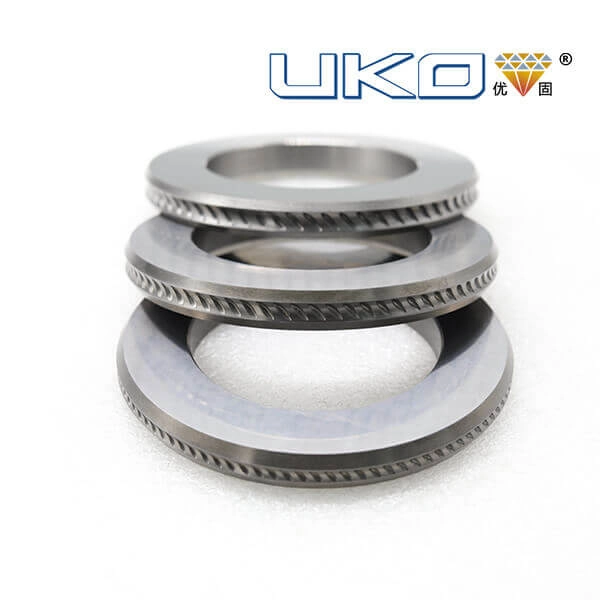


Resource

DESCALING ROLLS
Descaling rolls are made of tungsten carbide or steel and are used for the mechanical descaling of entry rod in reduction mills.
TUNGSTEN CARBIDE INSERTS FOR MECHANICAL DESCALING
Tungsten carbide inserts for the mechanical descaling of entry rod in reduction mills.

ZHUZHOU UKO’s tungsten carbide roll rings are exported to 80+ countries and serve 200+ customers. Over 60% of their customers have been in cooperation for more than 5 years. UKO aims to share their rich production experience in various stages and how they ensure product quality to increase customer loyalty and brand influence, ultimately becoming a leader in the Cemented carbide rolls industry.
Here are the advantages of ZHUZHOU UKO’s TC Rollers products:
Strict selection of raw materials: UKO places great emphasis on selecting high-quality raw materials. Their solid carbide rolls products use native materials from Xiamen Jinlu (GESAC). GESAC is currently considered the best domestic brand in terms of quality in China, albeit at a relatively higher price. The spray drying process ensures that the sprayed powder particles have good roundness, uniform size, high density after compression, and do not produce cracks, delamination, or uneven density after sintering. The spray tower used in UKO’s factory is the largest in the cemented carbide industry in Zhuzhou.
Advanced production process: UKO employs an advanced production process. They utilize a Riedel brand sintering furnace, which is considered the best domestically produced brand in China. The sintering process involves vacuum sintering up to 1350 degrees Celsius, followed by low-pressure sintering. The main purpose of low-pressure sintering is to reduce the micro-porosity in the tungsten carbide, which is an important indicator of high product quality.
Quality assurance: UKO adheres to strict quality control in every production stage and does not compromise quality for cost reduction. It is their commitment to maintaining high product quality that allows their roller ring series products to establish a strong position in the fiercely competitive market. Feedback from their TC ribbed roller distributor in Turkey indicates that UKO’s product quality is stable and even surpasses European brands, which is why they continue to insist on cooperation.
Technological innovation and continuous improvement: UKO is dedicated to investing more costs in product technological innovation and continuously improving their production processes to meet the industry’s new standards. They are willing to establish long-term cooperation with high-quality customers who share the same values and form a community of shared interests. UKO maintains a reasonable profit level and channels more resources into product technological innovation, constantly iterating their production processes to help customers enhance their market competitiveness.
In summary, the advantages of ZHUZHOU UKO’s TC Rollers products lie in their strict selection of high-quality raw materials, utilization of advanced production processes, commitment to quality assurance in every production stage, and continuous technological innovation. Through these advantages, UKO provides customers with excellent product quality and reliability, enabling them to stand out in the market.
Tungsten carbide roll rings find various applications in the manufacturing industry, particularly in processes that involve rolling and shaping. Some typical applications of tungsten carbide roll rings include:
Wire Rod Mills: Tungsten carbide roll rings are extensively used in wire rod mills for the production of wires and rods. They provide excellent wear resistance and dimensional stability, ensuring consistent product quality over extended rolling campaigns.
Bar and Rebar Mills: In bar and rebar mills, tungsten carbide roll rings are used to produce bars and reinforcing bars (rebars) from steel billets. These rings can withstand the high compressive forces and repetitive rolling cycles involved in the production of bars.
Seamless Tube Mills: Tungsten carbide roll rings are employed in seamless tube mills to shape and size the tubes. The high hardness and wear resistance of these rings enable them to withstand the demanding conditions and maintain precise dimensions during the rolling process.
Section and Structural Mills: Tungsten carbide roll rings are utilized in section and structural mills for the production of various profiles, such as beams, channels, angles, and rails. These rings ensure accurate shaping and consistent dimensions of the rolled sections.
Cold Rolling Mills: In cold rolling mills, tungsten carbide roll rings are used to reduce the thickness and improve the surface finish of metal sheets or strips. They provide excellent wear resistance and dimensional control, enabling precise and uniform rolling of the material.
Hot Strip Mills: Tungsten carbide roll rings are employed in hot strip mills to roll and shape heated slabs into hot-rolled coils. These rings are subjected to high temperatures and extreme pressures, and their exceptional hardness and toughness make them suitable for such demanding applications.
Foil Mills: Tungsten carbide roll rings are used in foil mills for the production of thin metal foils. The rings ensure precise thickness control and excellent surface quality during the rolling process.
These are just a few examples of the applications of tungsten carbide roll rings in the manufacturing industry. Their exceptional hardness, wear resistance, and durability make them indispensable components in various rolling and shaping processes, enabling efficient and high-quality production of metal products.
Tungsten carbide roll rings are specialized components used in the manufacturing process of mill rolls. These rings are designed to provide extended life and durability in applications where long rolling campaigns are required. They are commonly used in wire rod finishing blocks and certain shaping applications.
The main advantage of tungsten carbide roll rings is their extreme hardness, which allows them to withstand high levels of wear and abrasion. Compared to ordinary steel, these rings offer significantly improved wear resistance, strength, and toughness. They have a service life that is ten times longer than that of regular steel components, making them ideal for harsh abrasion environments.
Tungsten carbide roll rings are typically made from cemented carbides, which are divided into two main categories: conventional WC-Co alloys and corrosion-resistant alloys with a mixed binder Co-Ni-Cr. The specific composition of the binder varies based on the requirements of the rolling mill.
The mechanical properties of tungsten carbide roll rings are impressive. The bending strength can reach up to 2200 MPa, while the impact toughness ranges from 4 to 6 x 10^6 J/m^3. The hardness and wear resistance of the rings come from the tungsten carbide (WC), while the toughness and strength depend on the binding agents (Co-Ni-Cr).
Overall, tungsten carbide roll rings offer exceptional durability and performance, making them a preferred choice in industries that require reliable and long-lasting mill rolls.
The T.C roller is made of WC and CO by powder metallurgy. There are two types of WC roller: integral type and combined type (see cemented carbide roller sleeve). It was born with the development of metal processing industry after the advent of powder metallurgy technology in 1909.
Since the introduction of carbide drawing die in Germany in 1918, the research of cemented carbide in various countries has been stimulated, and rollers for various purposes have appeared one after another. However, the wide application of TC roller was after 1960. In 1964, the first high-speed non twist wire rod mill of Morgen company was born, which increased the finishing speed of wire rod four times at that time.
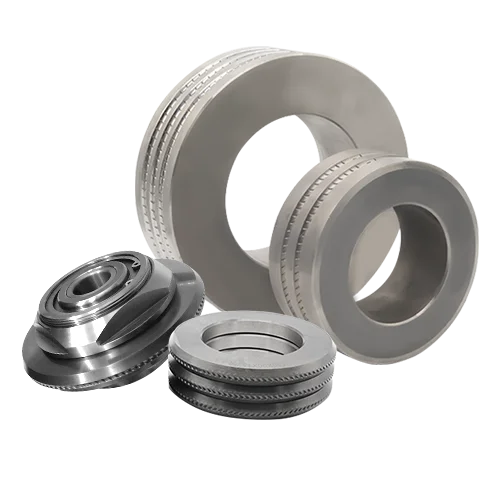
Because the finishing mill works under high speed and high stress, the wear resistance of cast iron roll and tool steel roll is poor, the service life of rolling groove is short, the repair and loading and unloading of roll are very frequent, which affects the efficiency of the mill and can not meet the requirements of finishing production. Therefore, it is replaced by a combined tungsten carbide roll. There are more than 200 sets of Morgan mills in the world, which consume hundreds of tons of WC rolls annually.
In the 1980s, tungsten carbide rolls developed in China have been successfully applied to high-speed wire rod mills. Ch series rolls of General Iron and Steel Research Institute of Ministry of metallurgy and YGH series rolls of Zhuzhou 601 plant have been mass-produced.
The composition, microstructure and properties of WC rolls vary with the working conditions of the rolls. Even for the same finishing mill, the composition of the rolls in different stands is different. The high-speed wire rod mill roll is mainly made of tungsten carbide with cobalt as a binder. Due to the poor water quality, a few continuous casting and rolling mills also use tungsten carbide rollers with Co-Ni Cr as binders, so the cost is low.
| T.C roller chemical composition & properties of grade | |||||
|---|---|---|---|---|---|
| Grade | Wc Content | Co Content | TRS | Density | Hardness |
| % | % | N/mm² | G/Cm³ | HRA | |
| YG15 | 85 | 15 | ≥2020 | 13.9-14.1 | ≥86 |
| YGH30 | 85 | 15 | ≥2700 | 14.02 | ≥84.9 |
The morphology of the TC roll is shown in figure:
- The properties of the rolls with two common components are shown in the table. The metallographic structure is composed of matrix phase WC and binder phase Co, as shown in Figure
- white phase is WC, black phase is Co. It can be seen from the table that the hardness of carbide roll increases with the increase of WC content; The toughness increases with the increase of binder content.

The application characteristics are shown in the table. The hardness of the WC roller is high, and its hardness value changes little with temperature. The hardness value at 700℃ is four times that of high-speed steel; The elastic modulus, compressive strength, bending strength and thermal conductivity of the tool steel are more than one time higher than those of the tool steel. All these properties ensure that the wear resistance and deformation resistance of WC roll are much better than that of tool steel roll in the working process, so as to ensure the smoothness of roll groove and the constancy of size, which is very important to ensure the surface quality and dimensional accuracy of wire rod.
Due to the high thermal conductivity of TC rolls, the heat dissipation effect is good, the time of high temperature on the roll surface is short, so the high-temperature reaction time of the roll with harmful impurities in the cooling water is short. Therefore, WC roller is more resistant to corrosion and thermal fatigue than tool steel roller.
Production method tungsten carbide rolls is produced by powder metallurgy method with tungsten carbide powder and cobalt powder (a small amount of other hard phases or alloy elements can also be added) as raw materials. The above two kinds of powders were wet ground and mixed by ball mill. After mixing, drying and sieving, the mixture become the intermediate product cemented carbide mixture. The mixture is pressed and sintered into roll blank. After grinding, polishing or re-grooving, the roll blank can be used for production.
The quality standards and influencing factors of T.C roller are: material porosity, WC grain size, total carbon and free carbon content, density, hardness, magnetic saturation strength, coercive force, bending strength, impurity content, etc. In addition, there are the machining accuracy and surface roughness of the roll. Each index reflects the quality of the roller and indicates its performance. The influencing factors of roller quality are: dispersion, particle size and particle size distribution of WC powder and Co powder in mixture, the content of total carbon, free carbon, oxygen and iron, etc; The type and quantity of binder, the temperature and time of degumming, the temperature, time and atmosphere of sintering, etc. In addition, the precision of the grinding machine and the quality of the diamond grinding wheel affect the quality of roll.
Tungsten carbide roller has been used in various fields of metal plastic processing. From non-ferrous metals to steel, from hot-rolled wire rod, pipe to cold-rolled foil, rebar and so on, tungsten carbide roller is used. China has been able to produce from φ 8~ φ There are dozens of varieties and specifications of 300 mm tungsten carbide rolls. However, with the high speed of wire rods finishing rolling (up to 130m / s), people are exploring ways to improve the hardness and strength of TC roller. This is mainly due to the addition of a small amount of TAC, NBC, Ni, Cr, Mo and other elements into the TC rolls; By means of hot isostatic pressing, vacuum sintering low pressure hot isostatic pressing, heat treatment and so on, the roller with better quality can be made.
Related content:
- Application of Carbide Roller in Steel Industry
- Application of various tungsten carbide rolls
- Roller holder for tungsten carbide roller
- Zhuzhou UKO Tungsten Carbide Cold Rolls for Ribbed Steel Wire
- Tungsten Carbide Mill Rollers for Rolling Ribbed Steel Bars
- What is the use of tungsten carbide roller ring?
- What is cemented carbide rolls?
- How are the ribs of cold rolled ribbed steel bars formed?
- How to distinguish between cold rolled steel bars and hot rolled steel bars?
Steel bar is a common building material, among which threaded steel is more commonly used in the building. Its scientific name is called cold-rolled ribbed steel. It is a bar that rolls round steel on the cold rolling mill and passes the carbide cold roller to form a regular section shape, which can improve its strength and adhesion with concrete.
The economic benefit is increased after the reinforcement is strengthened by cold working. But the yield strength of cold processed steel bar is relatively large, and the safety reserve is small. So what grade of steel is a cold-rolled ribbed steel bar, and what are its advantages?
Cold rolled ribbed steel bar has many advantages in our use. Its steel strength is high, which can save construction steel and reduce project cost. It can save about 40% steel when used in the cast-in-place structure; It can eliminate the phenomenon of the anchorage zone cracking and steel wire sliding, and improve the bearing capacity and crack resistance of the end of the component; The cold-rolled ribbed steel bar is elastic and not easy to bend when pouring concrete, which provides convenience for construction
Advantages of cold rolled ribbed bar:
Cold rolled ribbed steel bar is a new type of cold rolled ribbed steel bar developed in recent years. Its production process increases the process of tempering heat treatment, has obvious yield point, and the strength and elongation indexes are significantly improved.
- The steel has high strength, which can save construction steel and reduce project cost. Compared with hot-rolled plain round bar, LL550 cold-rolled ribbed bar can save 35% - 40% steel when used in cast-in-place structure (especially in roof).
- The bond anchorage performance between cold-rolled ribbed bar and concrete is good. Therefore, when it is used in the component, the phenomenon of cracking in the anchorage zone and steel wire sliding is fundamentally eliminated, and the bearing capacity and crack resistance of the end of the component are improved; In reinforced concrete structure, the crack width is smaller than that of plain round steel bar, even than that of hot rolled thread steel bar.
- The elongation of cold-rolled ribbed bar is higher than that of the same kind of cold-rolled steel.
Related content:
- Application of Carbide Roller in Steel Industry
- Application of various tungsten carbide rolls
- Roller holder for tungsten carbide roller
- Zhuzhou UKO Tungsten Carbide Cold Rolls for Ribbed Steel Wire
- Tungsten Carbide Mill Rollers for Rolling Ribbed Steel Bars
- What is the use of tungsten carbide roller ring?
- What is cemented carbide rolls?
- How are the ribs of cold rolled ribbed steel bars formed?
- How to distinguish between cold rolled steel bars and hot rolled steel bars?
Latest blog