
Carbide Plate
Carbide plates are mainly made from WC and cobalt powder by powder metallurgy methods, also known as tungsten carbide sheets and tungsten carbide blocks. UKO offers top and consistent quality carbide plates that are engineered through several procedures, including micro-grain tungsten carbide powder mixture, ball milling, pressing and forming, sinter-HIP, and quality inspection. The sinter-HIP reduces the porosity and increases the density of our tungsten carbide plates, ensuring our consistent quality. At the same time, isostatic pressing ensures the uniformity of density. We can provide various grades, such as YW1, YT15, YG6X, etc, and also customized services according to your requirements.
UKO’s tungsten carbide plates have excellent hardness, high hardness, good wear resistance, high modulus of elasticity, high compressive strength, and good chemical stability (acid resistance, alkali resistance, high-temperature oxidation resistance) Low impact toughness, low coefficient of expansion, heat conduction, and conductivity are similar to those of iron and its alloys.
Features:
- All carbide plates have been tested by non-destructive ultrasonic flaw detection before leaving the factory;
- No trachoma, no porosity, high material density;
- High strength, impact resistance, long service life.
Tungsten carbide plates divided as sintered blank and grinding, which meet different products applications, such as brazing tools, woodworking blades, mold materials, wear parts, etc. It is also widely used in the following industries:
- Used for making progressive press tools and progressive dies of high-velocity ram machine.
- Used for making connectors in electron industry, IC industry, and semiconductor.
- Used for armature, stator, LED lead frame, EI silicon steel sheet, and punching mold for hardware and standard parts.
Pulverizing → formula according to usage requirements → wet grinding → mixing → crushing → drying → sieving → adding molding agent later → drying again → sieving to obtain mixture → granulation → pressing → shaping → sintering → shaping (blank) → flaw detection → packaging → warehousing
| Grade | Density | Hardness | TRS | Recommended Application |
| g/cm³ | HRA | N/mm² | ||
| YG6X | 14.8~15.1 | ≥91.0 | ≥1750 | Has the high degree of hardness and the good resistance to wear, is suitable manufactures molds and so on forming tool, wear-resisting spare part. |
| YG6A | 14.6~15.0 | ≥91.5 | ≥1900 | |
| YG10X | 14.3~14.7 | ≥91.8 | ≥2200 | Has good wear resistance and corrosion resistance, and is suitable for making high-quality carbide inserts and high-feed carbide drills for ordinary steel, stainless steel, heat-resistant steel, nickel-based and titanium alloys, etc. |
| YG16X | 13.8~14.1 | ≥89.0 | ≥2000 | Has good overall performance, and is suitable for manufacturing the level to enter ramming molds and so on mold. |
| YG6 | 14.7~15.1 | ≥89.5 | ≥1670 | Has a high intensity, the resistance to wear is lower than YG6X, is suitable in manufacturing the forming tool, bears the abrasion spare part, etc. |
| YG8 | 14.6~14.9 | ≥89.0 | ≥2050 | |
| YG15 | 13.9~14.2 | ≥86.5 | ≥2450 | Suitable for manufacturing the ramming mold, bears the abrasion spare part, etc. |
| YG20 | 13.4~13.8 | ≥85.0 | ≥500 | Has a high intensity, and is suitable for manufacturing the level to enter ramming molds and so on mold. |
| YG20C | 13.4~13.7 | ≥82.5 | ≥2450 | It has good wear resistance and good toughness, and is suitable for cold heading, cold punching and cold pressing dies. |
Different specifications and designs in tungsten carbide wear plates can be customized. The surface condition is divided as-sintered blank and grinding, which meet various application needs.
- Used for Heat-resistant Parts, Wear-resistance parts, Anti-shielding parts, Anti-corrosion Parts.
- Used for making progressive press tools and progressive dies of high-velocity ram machine.
- Used for making connectors in electron industry, IC industry, and semiconductor.
- Used for armature, stator, LED lead frame, EI silicon steel sheet, and punching mold for hardware and standard parts.
SEM Pictures
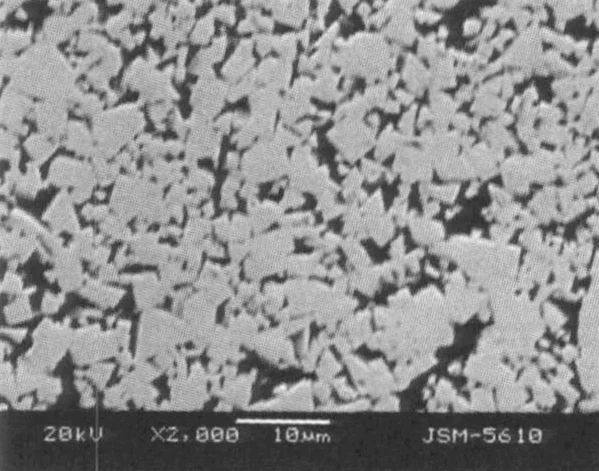
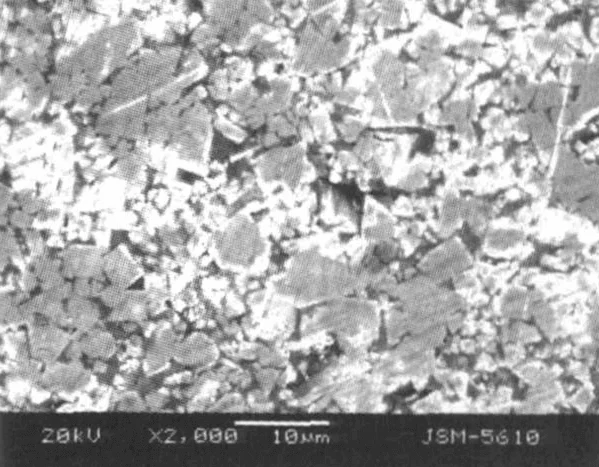
Note: As can be seen from the above SEM Pictures, the grain size of our product is uniform, most of the grain size is about 6μm, only a few small grains. The black binder phase not only solidifies the hard phase WC, but also effectively controls the growth of grains, making the microstructure of the alloy more reasonable.
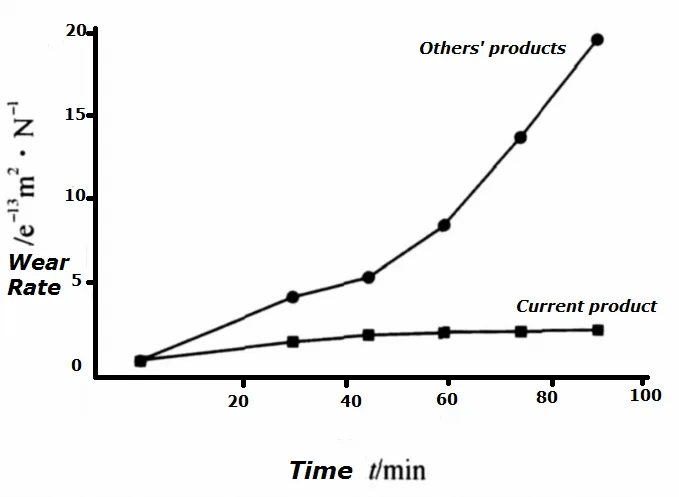
The microstructure of the cemented carbide plate has an important influence on the wear resistance. The uniform microstructure is conducive to the improvement of wear resistance, and the appropriately coarse WC grains can play a good anti-wear effect, but there must be enough bonding phase to fix the hard particles so that they will not peel off the particles. The large hard particles are coated in a large area in the bonding phase, and the particles are not easy to peel off, which helps to improve the wear resistance of the material.
Resource
Latest blog